

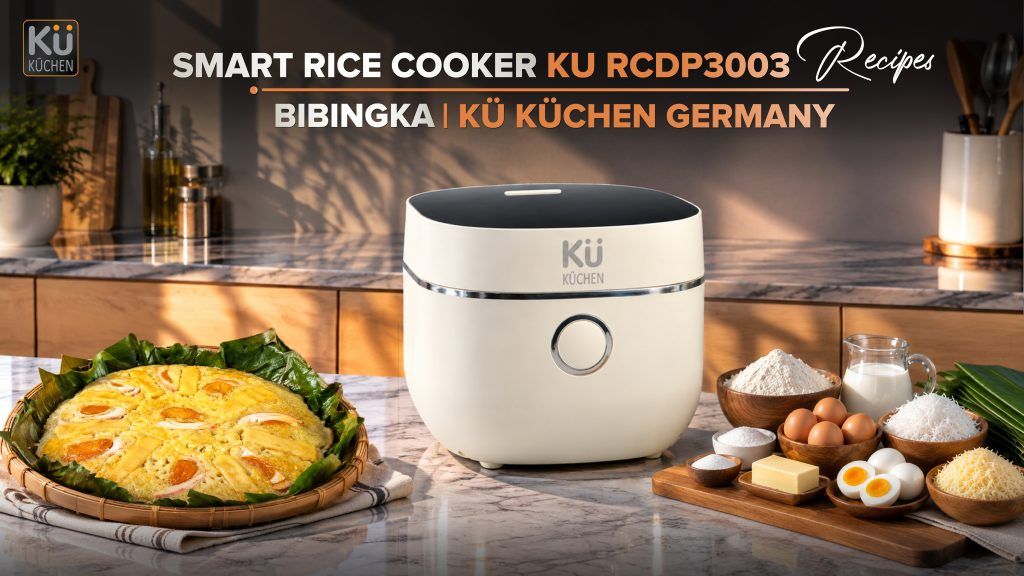
Bibingka is one of the Philippines’ most recognizable rice cakes, loved for its soft, slightly chewy texture, gentle coconut aroma and signature toppings of salted egg, cheese and butter.
Traditionally, Bibingka is cooked in banana-leaf-lined clay pots with heat applied from both above and below. For everyday home cooking, however, the recipe can be adapted to the dedicated Cake Mode of the KÜ KÜCHEN Smart Rice Cooker KU RCDP3003.
In this edition of SMART RICE COOKER KU RCDP3003 RECIPES, we prepare a simple homemade Bibingka using rice flour, coconut milk and familiar Filipino toppings.
Ingredients for Filipino Bibingka
For approximately 6–8 servings, prepare:
For the Bibingka batter
- 200 g rice flour
- 80–100 g granulated sugar
- 2 teaspoons baking powder
- ¼ teaspoon salt
- 2 large eggs
- 200 ml coconut milk
- 100 ml fresh milk
- 30 g melted butter
For the toppings
- 1–2 salted eggs, sliced
- 60–80 g grated cheese
- 20–30 g butter, for brushing
- Fresh grated coconut, for serving
- Sugar, optional
You will also need
- Banana leaves, enough to line the inner pot
Banana leaves are an important part of the character of Bibingka. Besides preventing direct contact with the pot, they add the familiar aroma associated with traditional versions of the dish.
Step 1: Prepare the Banana Leaves
Wash the banana leaves thoroughly and wipe them dry.
Pass each leaf briefly over low heat or another gentle heat source until it becomes softer and more flexible.
Do not burn the leaves. The goal is simply to soften them so they can bend without tearing.
Cut the banana leaves to fit the inner pot of the KU RCDP3003, allowing the edges to extend slightly upward along the sides.
Lightly brush the surface with melted butter.
Step 2: Prepare the Dry Ingredients
In a large mixing bowl, combine:
- Rice flour
- Sugar
- Baking powder
- Salt
Whisk briefly until evenly distributed.
Breaking up any lumps in the rice flour at this stage helps create a smoother finished Bibingka.
Step 3: Mix the Wet Ingredients
In another bowl, lightly beat the eggs.
Add:
- Coconut milk
- Fresh milk
- Melted butter
Whisk until evenly combined.
The coconut milk provides much of the characteristic aroma and richness of Bibingka, while the eggs help the cake hold its structure during cooking.
Step 4: Make the Bibingka Batter
Gradually pour the wet mixture into the bowl of dry ingredients.
Whisk gently until the batter becomes smooth and no large pockets of dry flour remain.
Avoid excessive mixing. Once the ingredients are evenly combined, stop mixing to help maintain a tender texture.
The batter should be pourable but noticeably thicker than ordinary milk.
Step 5: Prepare the KU RCDP3003
For this recipe, use the three-layer SUS 304 stainless-steel inner pot, which is suitable for the KU RCDP3003’s baking function.
Line the bottom and sides with the prepared banana leaves.
Make sure the leaves sit reasonably flat so the batter can spread evenly.
Pour the Bibingka batter into the lined inner pot.
Do not fill the pot excessively. The batter needs some room to rise while cooking.
Step 6: Add the First Toppings
Arrange the sliced salted eggs gently over the surface of the batter.
Press them only very lightly into the mixture rather than pushing them underneath.
Reserve the grated cheese for the later stage of cooking so it remains more noticeable on top of the finished Bibingka.
Step 7: Select Cake Mode
Place the inner pot into the KÜ KÜCHEN Smart Rice Cooker KU RCDP3003.
Close the lid and select:
Cooking Mode: Cake
Allow the programmed baking cycle to run.
As a general reference, Bibingka of this size may require approximately 45–60 minutes, although the exact cooking time can vary according to batter depth, ingredient temperature and the programmed cycle of the appliance.
The Dual-Sensor temperature system monitors heat during cooking, while the concave heating plate helps distribute heat across the base of the inner pot.
Step 8: Add the Cheese
Near the final stage of cooking, open the lid carefully and sprinkle the grated cheese evenly over the Bibingka.
Close the lid and continue the Cake program.
Adding cheese toward the end helps it soften and melt without disappearing too deeply into the batter.
Unlike a conventional oven with strong top heat, a rice cooker will not create exactly the same browned cheese surface as charcoal or oven-baked Bibingka. The texture, however, can still remain soft, moist and pleasantly rich.
Step 9: Check for Doneness
When the program finishes, insert a wooden skewer or toothpick into the center of the Bibingka.
If it comes out clean or with only a few moist crumbs, the cake is ready.
If wet batter remains on the skewer, continue cooking for another 10–15 minutes, depending on the appliance controls and the thickness of the Bibingka.
The center should feel set and spring back lightly when touched.
Step 10: Rest Before Removing
Once cooked, switch off the cooker and allow the Bibingka to rest inside for approximately 5–10 minutes.
Carefully lift it from the inner pot using the banana leaves.
Allowing the cake to rest briefly helps the structure settle and makes it easier to remove without breaking.
Step 11: Finish the Traditional Way
While the Bibingka is still warm, brush the surface with softened or melted butter.
Finish with:
- Additional grated cheese
- Fresh grated coconut
- A light sprinkling of sugar, optional
Serve the Bibingka warm.
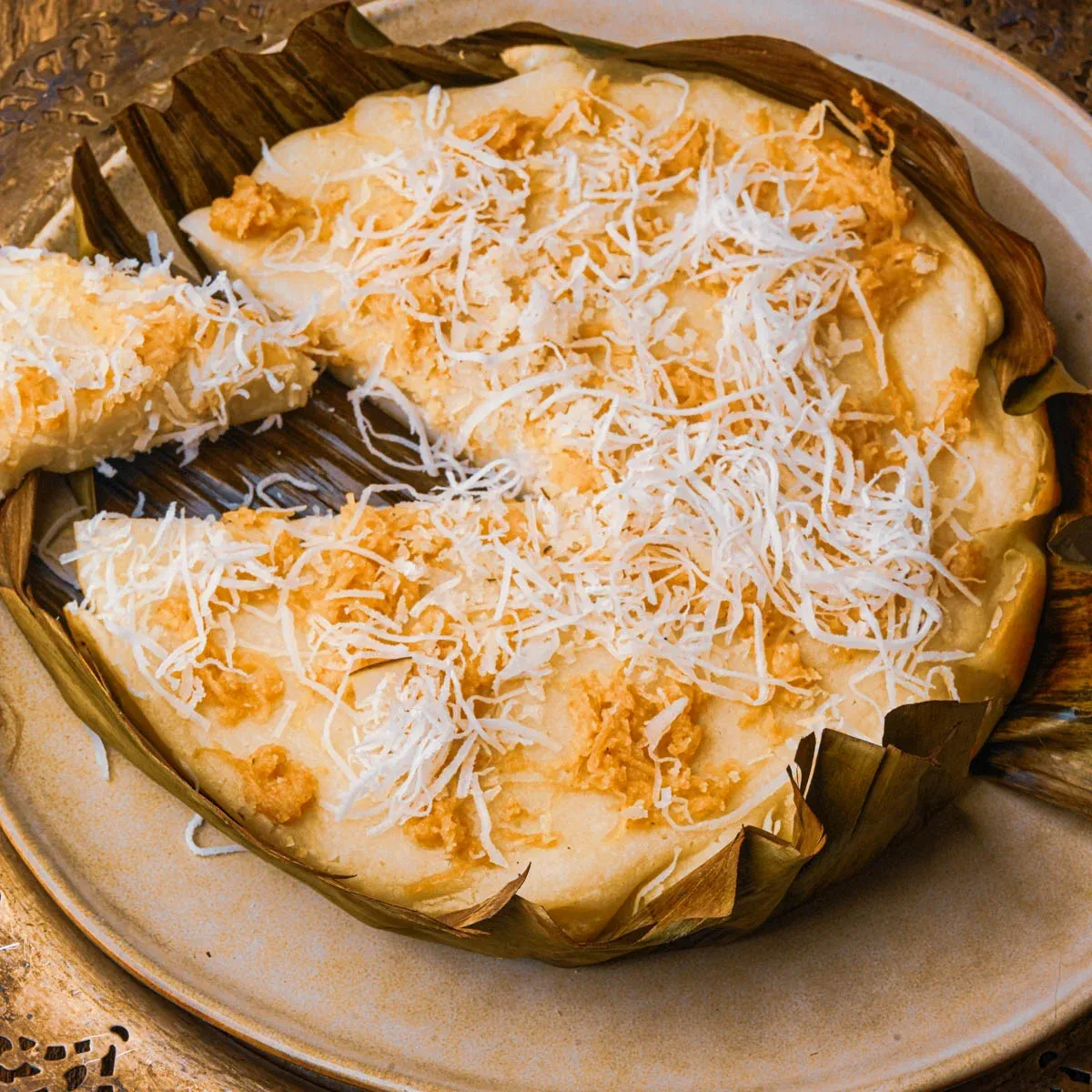
The finished cake should be soft and moist inside with a gentle rice-and-coconut flavor, complemented by savory salted egg, creamy cheese and fragrant banana leaves.
Why Make Bibingka with the KU RCDP3003?
The KÜ KÜCHEN Smart Rice Cooker KU RCDP3003 is designed to handle much more than everyday rice.
Among its 10 dedicated cooking functions, the Cake Mode expands the cooker into a practical appliance for simple homemade desserts and rice-based cakes such as Bibingka.
For this recipe, several features are particularly useful.
Dedicated Cake Mode
The dedicated baking program provides controlled heating without requiring users to continuously monitor a stovetop or conventional oven.
Dual-Sensor Temperature Control
The KU RCDP3003 monitors temperature through sensors located at both the base and upper section of the cooking system.
This helps the cooker manage heat more consistently throughout the cooking cycle.
Concave Heating Plate
The curved heating plate increases contact with the inner pot and supports more even heat distribution from the base.
For a thick rice cake such as Bibingka, consistent heat helps the center cook through without relying on excessively high temperatures.
4L Capacity
The 4-liter capacity provides enough room for a family-sized Bibingka while still leaving space for the batter to rise.
Why Use the Stainless-Steel Inner Pot?
The KU RCDP3003 comes with two premium inner pots:
- Nano-Ceramic coated cast-iron inner pot
- Three-layer SUS 304 stainless-steel inner pot
For this SMART RICE COOKER KU RCDP3003 RECIPES – Bibingka, the SUS 304 stainless-steel inner pot is a suitable choice because the product is designed to support the Cake Mode with this pot.
The three-layer construction combines stainless steel with an aluminum heat-conducting core, supporting efficient and even heat transfer.
The banana-leaf lining also creates a natural layer between the batter and the stainless-steel surface while contributing additional aroma.
Tips for Better Homemade Bibingka
A few small details can make a surprisingly large difference. Humanity did, after all, spend generations perfecting rice cake. Respect the accumulated carbohydrate knowledge. 😌
- Use fresh baking powder: This helps the Bibingka rise properly.
- Do not overmix the batter: Mix only until smooth.
- Use room-temperature ingredients: They combine more evenly.
- Soften the banana leaves first: Cold or stiff leaves tear easily.
- Do not add too much batter: Leave enough space for expansion.
- Add cheese near the end: This keeps it more visible and creamy.
- Let the Bibingka rest before removing: The cake will hold its shape better.
How to Serve Filipino Bibingka
Bibingka is best enjoyed while still slightly warm.
Cut it into wedges and serve with:
- Fresh grated coconut
- Extra butter
- Grated cheese
- Coffee
- Hot chocolate
- Tea
Its combination of sweet rice cake, coconut, butter, cheese and salted egg makes it suitable for breakfast, merienda, family gatherings or festive occasions.
Traditional Filipino Flavor with Modern Convenience
Bibingka is deeply associated with Filipino food culture, especially during the Christmas season, but there is absolutely no sensible reason to limit good rice cake to one month of the year.
With rice flour, coconut milk, eggs and familiar toppings, the recipe remains relatively simple. The KÜ KÜCHEN Smart Rice Cooker KU RCDP3003 then handles the controlled cooking stage through its dedicated Cake Mode.
The result is a soft, moist and fragrant Filipino Bibingka topped with salted egg, cheese and butter, while banana leaves provide the familiar aroma that gives the dish its distinctive character.
This SMART RICE COOKER KU RCDP3003 RECIPES – Bibingka is an easy way to bring a traditional Filipino favorite into everyday home cooking.
Soft rice cake, creamy coconut, savory salted egg and melted cheese: homemade Bibingka made more convenient with the KÜ KÜCHEN Smart Rice Cooker KU RCDP3003.


